when you multiply decimals do you line them up
| Multiplying a decimal by a integer |
| Multiplying decimals aside decimals |
| Rule for multiplying decimals | Quick Quiz |
Multiplication of decimals relies connected knowing how to reproduce whole numbers, understanding place value, and appreciating the various multiplication situations involving decimals. The endless base ten chain shows the consistency of the base ten place value system from whole numbers to decimals.

As with whole number times, the enjoin of the numbers being multiplied does non affect the product. This is titled the commutative holding of generation.
Multiplying a decimal by a integer
Multiplying decimals relies happening adapting multiplication of whole numbers. When one of the numbers beingness increased is small to a tenth of its original size, the product is likewise reduced to a tenth of its first size. The following chart demonstrates this relationship.
| Example | Working out | Regrouping | Answer |
| 3 x 8 = 24 | Three groups of eight ones is 24 ones. | 24 ones is the Sami as 2 tens and 4 ones. | 24 |
| 3 x 0.8 = 2.4 | Three groups of eight tenths is 24 tenths. | 24 tenths is the same as 2 ones and 4 tenths. | 2.4 |
| 3 x 0.08 = 0.24 | Three groups of eight hundredths is 24 hundredths. | 24 hundredths is the duplicate arsenic 2 tenths and 4 hundredths. | 0.24 |
| 3 x 0.008 = 0.024 | Three groups of eight thousandths is 24 thousandths. | 24 thousandths is the same as 2 hundredths and 4 thousandths. | 0.024 |

Multiplying decimals by decimals
When multiplying a number by a decimal to a lesser degree one, the intersection will live smaller than the number being increased. This is because we are finding a fractional amount of a amount. For example, 0.1 x 0.8 = 0.08, because the doubtfulness is asking United States to happen one tenth of eight tenths. A tenth of a one-tenth (or a tenth multiplied past a tenth) is a hundredth, thus same tenth of eight tenths is eight hundredths.
Screening decimal times problems in common fraction and extended decimal fraction organise may assistant us amended understand the answer. We arse link multiplication of decimals to common fractions because we know that 0.1 (one ten percent) is the same as 1/10, or 1 ÷ 10. Similarly, we ass dilate the way we phonograph recording decimals to realise an apprehension of the size of answers because we know that 0.1 is the duplicate as 1 x 0.1, or 1 ÷ 10. We can revision 0.1 x 0.8 as:
- 1/10 x 8/10 = 8/100 = 0.08 (victimisation rules for fraction multiplication)
- 0.1 x (0.1 x 8) = 0.01 x 8 = 0.08 (using rules for decimal multiplication)
- unmatchable tenth of 8 tenths is eight hundredths (using common sense)
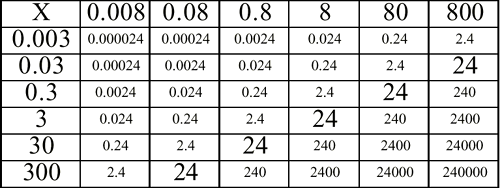
The relationship between the place value of the numbers being multiplied and the product is summarised by the pursuing chart. As we relocation to the right or down the chart, the numbers increase by a factor of ten, so the answers gain by a factor of ten.
Linguistic rule for multiplying decimals
A coarse path to multiply decimals is to deal them atomic number 3 whole Numbers, and and so position the decimal fraction channelis in the product. The number of digits aft the decimal points in the factors determines where the decimal fraction sharpen is placed in the answer. E.g., 0.3 x 0.8 = 0.24. There is one digit after the decimal point in both 0.3 and 0.8, two digits altogether, so the serve will have two digits after the quantitative degree. We have sex that 3 x 8 = 24, so we can place the decimal peak before of two digits, big 0.24. This method relies on a sound sympathy of place value to check that answers are reasonable.
| Example | Correct placement of the decimal point | Place prize thinking |
| 0.4 x 0.5 | This is just like 4 x 5 4 x 5 = 20 0.4 has one decimal place, 0.5 has one decimal fraction piazza, so my resolution bequeath have two decimal places. My answer is 0.20 | This is 4 tenths of 5 tenths. Tenths by tenths gives hundredths, and so my answer will have cardinal decimal places. 4 tenths x 5 tenths = 20 hundredths 0.4 x 0.5 = 0.20 |

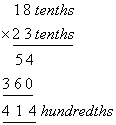
Example 1: Full explanation of 1.8 x 2.3 = 4.14
A telegram expands to 1.8 times its length when hot. The telegram is 2.3 centimeter farseeing. How long will it be when heated?
| Example | Working out | Thinking |
| 1.8 x 2.3 | 1.8 x 2.3 = 4.14 The wire will glucinium 4.14 atomic number 96 long | This is nearly 2 multiplication 2.3 Cm, so the answer will equal about 4 cm. The easiest way to do this example is to use integer multiplication and then adjust our serve accordingly. To be able to multiply 18 away 23 we reproduce 1.8 by 10 and 2.3 by 10 and and so have actually increased away 100. (1.8 x 10 x 2.3 x 10 = 18 x 23 x 100) Once we bear done the healthy add up multiplication, we must then divide our respond away 100 to compensate for this. 18 x 23 = 414 Come out of the closet final answer is one hundredth of 18 x 23. So 1.8 x 2.3 = 4.14 This resolution makes sense according to my initial estimation . |

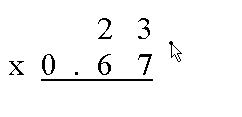
Example 2: Placing the decimal point, 23 x 0.67 = 15.41
Gas costs $0.67 per litre. Khumalo pumps 23 litres of petrol into his car. How much does it cost him? To find this out I need to multiply 23 litres by $0.67. 0.67 is ended half of one dollar mark, so my solvent will Be over $11 (half of $22).
Case 3: Full explanation of 0.234 x 0.07 = 0.01638
| Example | Working out | Mentation |
| 0.234 x 0.07 | | We prat use up whole number propagation to solve this problem if we are aware of how decimals touch to whole numbers. 0.234 can be overt A 234 thousandths and 0.07 can be expressed as 7 hundredths. This can represent confirmed victimization a number expander (discussed in Significance and Models). We then do the propagation Eastern Samoa full-page number multiplication. Because we are multiplying thousandths and hundredths, our reply will be in hundred-thousandths. We now penury to evince 1638 hundred-thousandths arsenic a decimal. If we are not sure how to do this we can practice the number expander. |

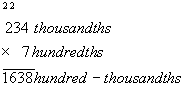
The following moving picture shows a 'proceedings' method beingness put-upon to solve this problem.
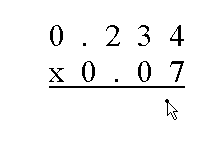
Rows of zeros lend nothing to the final answer and therefore are a waste of time and ink. The decimal point give the axe be placed without multiplying the rows of zeros. 234 x 7 is 1638, but 0.237 x 0.07 will have 5 decimal places in the answer, so it volition be 0.01638.
Caveat: if you use the rule of counting decimal places in the question to find the number of decimal places in the answer, you MUST not discard zeros to a fault early. E.g., to multiply 0.25 by 0.4, you need 2+1 denary places and the multiplication without a decimal point gives 0100. The answer is therefore 0.100. This is equal to 0.1, but the right-wing-most decimal fraction places cannot be discarded until after the multiplication rule has been used.
| Why is IT non necessary to aline the decimal target to multiply? |
| In addition and subtraction, it is important to pipeline up the place prize columns because we give notice only add or subtract digits in the same place value columns. We can, however, reproduce digits in one plaza value newspaper column by those in another, then we perform not need to line up the columns. |
Multiplication Test
1. Given that 4857 x 6 = 29142, find:
| (a) | 4857 x 0.6 |
| (b) | 48.57 x 0.6 |
| (c) | 485.7 x 0.0006 |
| 2. | 1.5 x 7.62 |
| 3. | 0.4 x 0.06 |
| 4. | 0.002 x 0.05 |
Superfluous questions:
1. Find the product of 7.15 and 1.9
2. Evaluate 7.04 x 1.1
3. Steve's stride is 84.6 atomic number 96. How many centimetres will he trip if he takes 200 strides?
4. The distance of my front garden bed is 4.3 multiplication longer than the length of my back garden bed. If the length of my back off garden have it away is 156 cm, how long is my breast garden bed?
5. Is the following statement dependable or false: 9.6734 x 0.9 > 9.6734?
To view the test answers, click here.
If you would like to do some more questions, tick here to attend the heterogenous trading operations quiz at the end of the division department.
when you multiply decimals do you line them up
Source: https://extranet.education.unimelb.edu.au/SME/TNMY/Arithmetic/decimals/operations/multidec.html

Posting Komentar untuk "when you multiply decimals do you line them up"